I just swapped to Stalwart two (2) weeks ago from another provider. I have what I believe everything configured correctly but we are still seeing delays in send/receive and sync progression with some end users on Outlook itself. Personally using betterbird and I am finding that the send/receive and sync times are working correct.
I am wondering if there is anyway we can speed up the send/receive and sync progression when it talks to the Stalwart DB. We are noticing the delay with it happening now compared to our old provider.
Relevant info:
Outlook IMAP sync very slow and load-dependent (150–770 msgs/s) — per-message DB round trips, PostgreSQL backend, 0.16.21
SUMMARY
Since migrating 554 accounts from VPOP3 to Stalwart (cutover Oct 6–7, 2026), Outlook (IMAP) users see slow or never-completing Send/Receive and folder sync. A flag-only fetch (UID FETCH 1:* (FLAGS)) runs
at 650–770 msgs/s when the system is quiet but drops to 150–210 msgs/s at busier times, on the same folders. PostgreSQL is fast and lightly loaded (~0.06–0.09 ms per query); the time appears to be spent
in sequential Stalwart ↔ PostgreSQL round trips (several per message) and in waiting for a pooled connection while each request crosses the network. We would like confirmation of the cause and guidance on the best fix (configuration, deployment layout, storage backend, or upgrade path).
ENVIRONMENT
Stalwart
- Version 0.16.21 (Enterprise), Ubuntu 24.04.4 LTS, kernel 6.8.0-142-generic
- Proxmox VM: 8 vCPU, 15 GB RAM. CPU 140–210% during business hours; RSS 2.6–3.1 GB
- Stores: DataStore = PostgreSQL (TLS on, poolMaxConnections 10 (raising to 30 once we can restart the service), timeout 15000 ms, poolRecyclingMethod
fast, no read replicas). BlobStore, SearchStore, InMemoryStore = Default (all on the same PostgreSQL
data store). Full-text search is therefore in PostgreSQL (s_email). - Cache: messages 4 GB (raised from 1 GB; active since restart Oct 21 00:28 UTC), accessTokens 64 MB,
accounts 64 MB. No measurable effect; RSS stays ~3 GB.
PostgreSQL (dedicated physical server)
- PostgreSQL 16.15, 251 GB RAM, ZFS (ARC c_max 64 GB) on 2 x 14 TB KIOXIA enterprise SSDs
- shared_buffers 32 GB, effective_cache_size 160 GB, work_mem 64 MB, maintenance_work_mem 2 GB,
max_connections 300, random_page_cost 1.1 - Network: 1 GbE (DB server NIC speed 1000 Mb/s). The Stalwart VM shares its Proxmox host’s 1 GbE
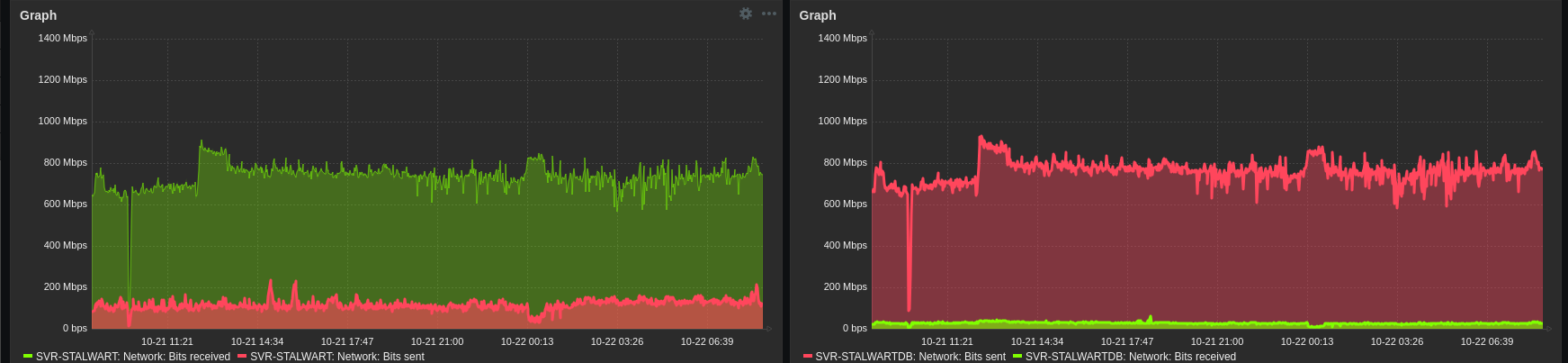
uplink with other VMs. DB server sends ~690 Mbps to Stalwart sustained (~70% of link), 24/7. - RTT Stalwart → PostgreSQL: quiet 0.20 ms avg / 0.49 ms max; busy 0.31 ms avg / 0.89 ms max;
loopback on the DB server 0.04 ms
Database (total ~2.8 TB)
- t 2662 GB | s_email 101 GB | p 75 GB (incl. TOAST) | k 5.7 GB | l 1 GB | others < 1 GB
- Largest indexes: gin_s_email_body 14 GB, p_pkey 3.5 GB, k_pkey 3.0 GB, t_pkey 1.1 GB
- NOTE: we added one custom index: idx_s_email_accid_rcvd (accid, rcvd) INCLUDE (docid), which cut
the date-window query “SELECT docid FROM s_email WHERE accid = $1 AND rcvd >= $2” from ~260 ms to
~12 ms. Please advise whether this is safe to keep, including for future schema migrations.
Workload
- 554 accounts, 5 domains; 25 mailboxes between 46 and 117 GB; large accounts hold 40k–124k messages across 49–76 folders, folders up to ~60k messages
- Clients: mostly Outlook in IMAP mode (no CONDSTORE/QRESYNC), some Thunderbird/Betterbird,
Nextcloud Mail polling ~130 accounts, mobile devices - Previous server (VPOP3) also used an external PostgreSQL database and handled the same clients without this issue
MEASUREMENTS
Flag-only sync (SELECT folder, then UID FETCH 1:* (FLAGS)), all folders of an account:
- Account A, 49 folders / 123,862 msgs: 11:54 ADT 162.8 s (761 msgs/s) | 14:10 ADT 596.6 s (208 msgs/s)
- Account B, 76 folders / 41,574 msgs: 11:56 ADT 60.5 s (687 msgs/s)
- Account B, single folder ~14k msgs: 11:56 ADT 18.1 s (772 msgs/s) | 14:34 ADT 96.4 s (150 msgs/s)
- Earlier (Oct 20): 1,929-msg folder 12.5–14.4 s; 27,579-msg folder 215 s (6–8 ms/msg)
- During a VACUUM of s_email: Account B 212.9 s (195 msgs/s)
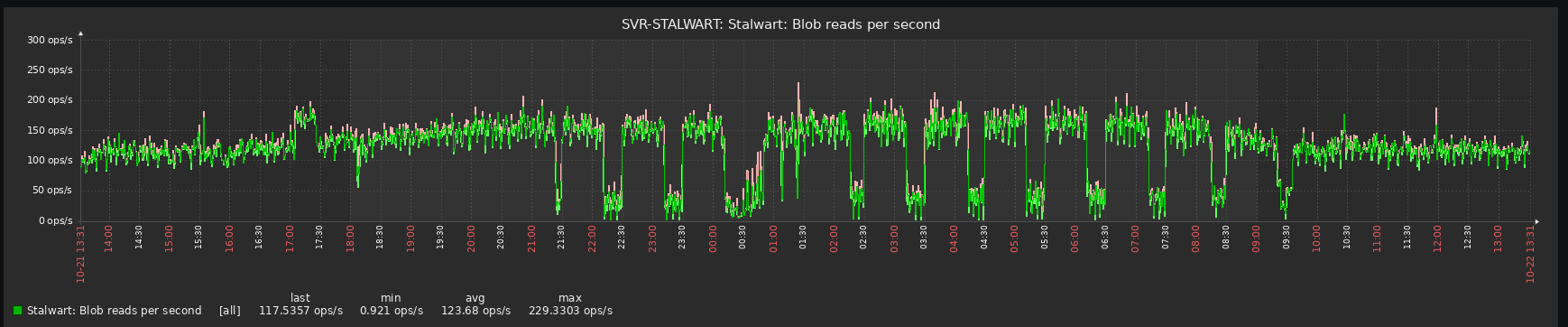
Performance is not tied to mailbox size; it varies ~5x with overall load on the same folders.
PostgreSQL side (same periods)
- Transactions/s from Stalwart: 14,555 (quiet) / 16,116 (busy)
- Non-idle Stalwart backends (100–200 samples): avg 1.3 / 1.0, max 6 / 4
=> PostgreSQL service time ~0.06–0.09 ms per query; DB is not saturated - Active-query sampling: 195 of 200 samples = “SELECT v FROM p WHERE k = $1”
- Cache: ~92% of p reads served from PostgreSQL memory; ZFS ARC hit rate 90.6%; disks lightly
loaded (13–23 MB/s, 600–1,600 reads/s) - Per-table read rate, before → after vacuum: s_email ~295 → ~160 MB/s; p ~246 → ~217 MB/s
OUR INTERPRETATION (please confirm or correct)
- Each message in a FLAGS fetch costs several sequential round trips to PostgreSQL. Community thread support.stalw.art #840 describes per-message round trips in 0.16.x being fixed in 1.0 without a
backport. At ~5–6 trips x (0.2–0.3 ms network + ~0.07 ms DB), this matches the ~1.3–1.5 ms per message we see when the system is quiet. - A pooled connection is held for the whole round trip, not just DB execution time. At 16,000
queries/s x ~0.37 ms per round trip, ~6 of the 10 pool connections are in use on average, so bursts from Outlook syncs likely exhaust the pool and requests queue inside Stalwart. That would
explain the sharp, load-dependent slowdown while PostgreSQL looks idle. - Network latency also rises under load (0.20 → 0.31 ms avg, max 0.89 ms) on a ~70%-utilized
shared 1 GbE link, lengthening every round trip.
ACTIONS TAKEN
- Stalwart cache raised (messages 4 GB, accessTokens/accounts 64 MB): no effect
- Expunge timers set (Trash/Junk 30 days, Email Submissions 3 days)
- PostgreSQL maintenance Oct 21: throttled VACUUM ANALYZE of l, p (incl. TOAST) and s_email (incl.
TOAST), removing ~9 M dead tuples from p and ~3 M from s_email; per-table autovacuum scale factor
0.02; autovacuum cost limit raised. Note: throughput dropped sharply for hours afterwards, likely cache eviction from the vacuum reading ~175 GB through a 64 GB ZFS ARC. - Custom index idx_s_email_accid_rcvd added (see above)
- Stopped unattended upgrades from restarting PostgreSQL (it had interrupted syncs at night)
- Outlook server timeout raised to 10 min for a client stuck in a reconnect loop (logins dropped
from ~53/h to ~10/h) - poolMaxConnections raised 10 → 30 (takes effect at next restart). Result: [pending]
OPTIONS WE ARE CONSIDERING
a) Run Stalwart on the PostgreSQL server (loopback, no TLS on the DB connection, 64 cores)
b) Raise shared_buffers to ~96 GB so p and its TOAST stay resident
c) Upgrade to 1.0 when released
QUESTIONS
- Can you confirm the per-message round-trip behaviour for FETCH FLAGS in 0.16.21 (thread #840)?
Is there a patch, backport, setting or workaround for 0.16.x, and an expected timeline for 1.0? - Is our reading of the connection pool right (connections held for the full round trip)? What
poolMaxConnections do you recommend for 554 accounts / ~16k queries/s, and is there a metric or log event that shows time spent waiting for a pool connection? - Of options a–c above, which do you recommend? For (a), any concerns running Stalwart on the
database host? - Is TLS on the DB connection a significant cost at ~16k round trips/s, and is disabling it over a
private network or loopback a supported, recommended setup? - Are there settings that reduce work for clients without CONDSTORE/QRESYNC (Outlook) doing repeated full-flag syncs?
- Is the custom index on s_email safe to keep, and will 1.0’s schema migration handle it?
- Should full-text search (s_email, ~100 GB, 17.6 M rows) move to a dedicated SearchStore at this size?
- What tracing or data would you like captured during a slow period, and how should it be enabled safely in production? (We operate 24/7.)